HR Templates Malaysia
Practical HR document templates to standardize workforce handling, improve internal consistency, and strengthen documentation discipline.
Definition of HR Templates
HR templates are repeatable document structures used to standardize how HR actions are recorded and communicated. Instead of drafting from scratch each time, teams use the same format to capture key details such as dates, roles, expectations, and outcomes. This reduces inconsistency and helps ensure essential information is not missed during common workforce situations.
Templates also make records easier to review because the structure stays consistent. When similar cases happen, management can compare documentation without decoding different writing styles. Over time, this strengthens clarity and continuity, especially when templates are aligned with broader workflows supported by structured HR services.
Why Templates Matter for Workforce Consistency
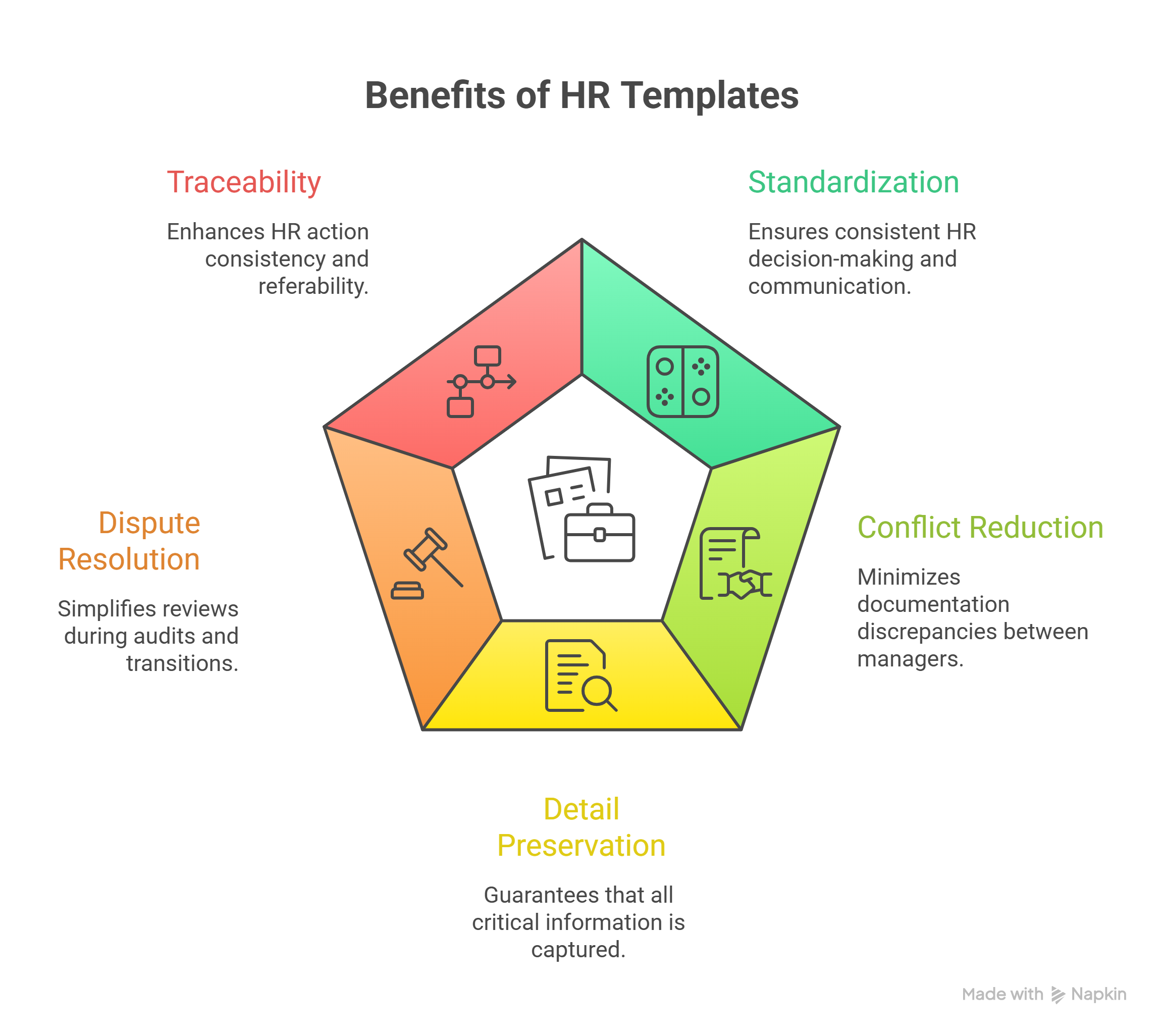
Without templates, HR documentation tends to become fragmented. Different supervisors write in different ways, key details get missed, and similar situations may be handled inconsistently across departments. This gradually reduces clarity and makes it harder to verify what was communicated, what was agreed, and what outcomes were recorded.
Templates stabilize workforce communication by keeping structure and language more consistent. This improves traceability of decisions and reduces avoidable back-and-forth. Many teams reinforce proper usage through capability building such as HR training so that managers apply documentation consistently in real-world operations.
Common HR Template Types
A strong template library does not need to be large. Most organizations benefit from a focused set that covers recurring workforce actions. The key is consistent usage, not collecting documents. Templates are commonly grouped into hiring, onboarding, performance handling, internal communication, incident recording, and exit transitions.
- Hiring and onboarding (role details, onboarding checklist, probation / confirmation notes)
- Workplace policies (attendance, leave, workplace communication, conduct guidelines)
- Performance handling (review notes, feedback records, improvement discussion notes)
- Workforce communication (memos, reminders, announcements)
- Incident documentation (fact recording, discussion notes, outcome summaries)
- Exit and transitions (handover checklist, internal clearance steps)
Teams typically start with templates that reduce the most operational confusion: onboarding clarity, performance notes, and recurring communication. When these are stable, templates can be expanded and aligned with improvement work via HR consulting and mapped into HR services in Malaysia for stronger governance flow.
How to Use HR Templates Effectively
Templates only work when teams know exactly when to use them, who completes them, and how records are stored. If usage is optional, departments will drift into different versions and inconsistent wording. Effective use starts with mapping templates into workflows and assigning owners for completion and review.
- Assign a clear owner for each template type (complete + review responsibility)
- Standardize naming and storage so records are easy to find and compare
- Use templates for recurring situations, not only during conflicts
- Keep wording consistent across departments
- Review completed records periodically to confirm consistent application
When templates become part of routine operations, documentation transforms into an operational asset. Teams with limited capacity sometimes pair template usage with HR outsourcing to ensure consistent execution while governance still refers back to HR services in Malaysia.
Maintaining Documentation Consistency Over Time
Templates drift when multiple versions circulate. Managers may save their own copies, edit formats, or reuse outdated documents. This breaks standardization quietly. A stable approach is version control: one current template set, clear ownership, and a single access location that teams use consistently.
Consistency improves when leadership expects documentation discipline as normal practice. Periodic review of completed templates helps verify that structure and language remain aligned across departments. If templates are intended to support governance, they should connect to workflows and decision routines under HR services in Malaysia.
HR Templates for SMEs in Malaysia
SMEs often rely on informal workforce handling because it feels faster. However, as headcount grows, informal communication creates ambiguity and inconsistent decisions. Templates help SMEs build a baseline of clarity without adding unnecessary complexity.
Most SMEs start with templates for onboarding clarity, performance notes, workplace reminders, and incident recording. Once usage is stable, templates can be integrated into broader improvement plans through HR consulting and reinforced via HR training, while authority and structure remain aligned with HR services in Malaysia.
Standardized Documentation
Keep recurring HR actions consistent by using the same structure across managers and departments.
Operational Traceability
Make decisions easier to review by capturing key details in a repeatable format.
SME HR Readiness
Build a practical documentation baseline that supports growth without operational overload.
Select high-impact templates based on recurring workforce actions.
Assign owners and align naming + storage for traceability.
Use consistently across departments for repeatable handling.
Audit usage periodically and refine formats to fit workflow reality.
They standardize HR documentation so recurring workforce actions can be recorded and communicated consistently.
No. Templates support documentation and communication structure. Decisions still depend on internal governance and judgment.
Onboarding clarity, performance notes, workplace communication, and incident recording are common starting points.
Use version control, assign template owners, standardize storage, and review completed records periodically.
Yes. Templates become stronger when embedded into workflows and aligned with consulting, training, and HR operations planning.
Templates support repeatable documentation for onboarding, performance notes, workforce communication, and incident recording.
Standard formats reduce variation and improve clarity across managers and departments.
Templates improve consistency, but results depend on correct usage and version control.
Start with a focused set, assign owners, and standardize storage before expanding the library.
Build Consistent HR Documentation
Use templates that fit your workflow and connect documentation into practical governance routines.
Explore HR Templates